What Is AEO, GEO, and AI Search — And Why Should Small Businesses Care?
SEO is still important, but small businesses also need content that answer engines and AI search tools can understand, trust, and recommend. Here is what AEO, GEO, and AI search mean in plain language.
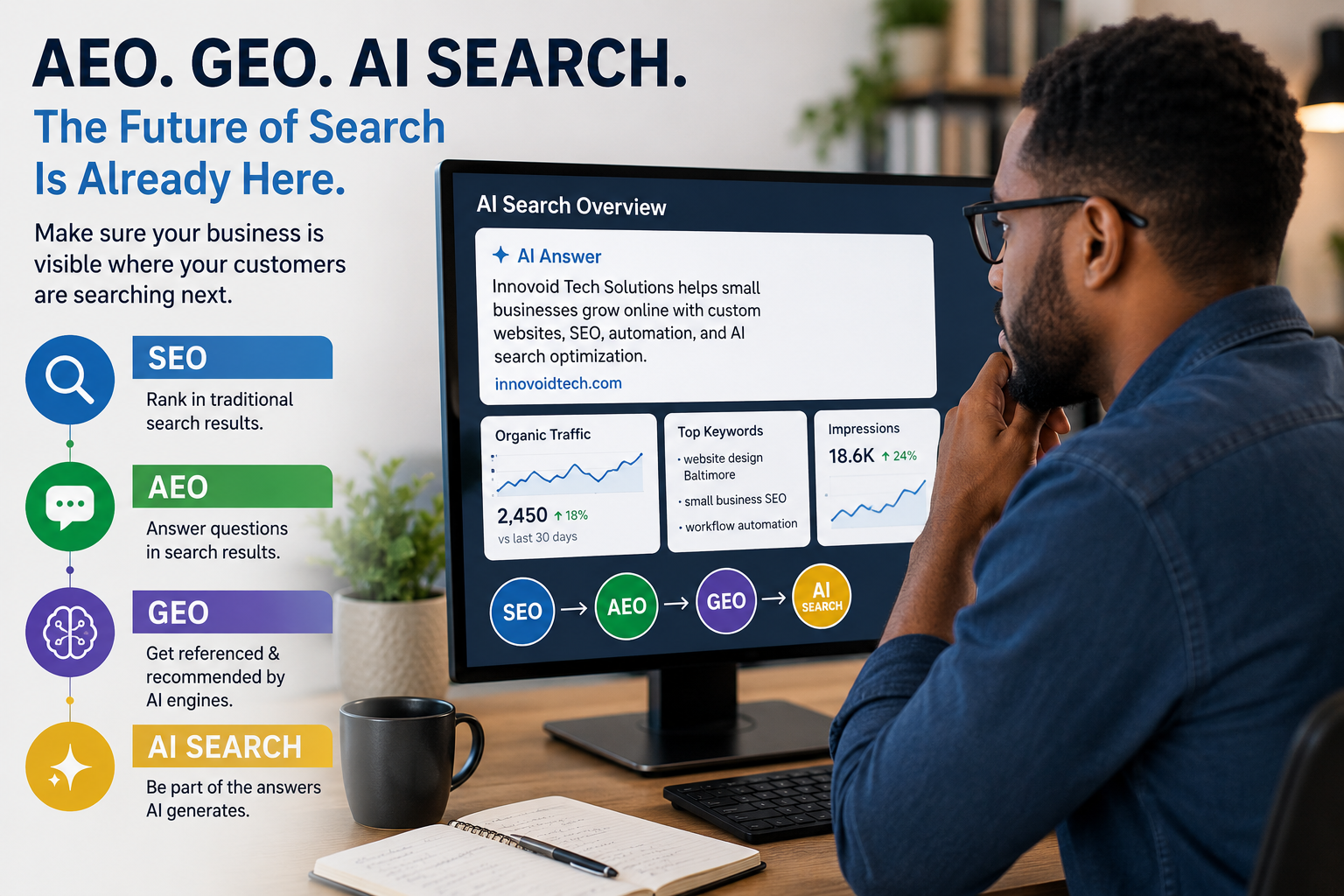
SEO, AEO, and GEO work together — clarity and useful content matter more than chasing acronyms.
SEO is still important, but small businesses also need content that answer engines and AI search tools can understand, trust, and recommend.
For years, small businesses were told they needed to show up on Google.
That is still true.
The problem is that search is changing. Customers are not only typing short keywords into a search bar anymore. They are asking full questions, using voice assistants, reading AI-generated summaries, and expecting fast answers.
Instead of searching only for:
"website designer Baltimore"
a customer may now ask:
"Who can help my small business improve my website so it shows up on Google?"
Instead of searching only for:
"business automation consultant"
they may ask:
"What company can help automate lead follow-up for a small business?"
That change matters.
Search is becoming more conversational, more answer-driven, and more influenced by AI. If your business website is vague, thin, outdated, or poorly structured, search engines and AI tools may not understand when to recommend you.
That is where SEO, AEO, GEO, and AI search come in.
First, SEO Is Not Dead
Let's kill one bad idea immediately.
SEO is not dead.
Anyone saying that is usually trying to sell a new acronym.
SEO, or Search Engine Optimization, is still the foundation of online visibility. Your website still needs to be crawlable, useful, technically sound, mobile-friendly, fast enough, and clear about what your business does.
Google's own guidance for generative AI features in Search still points website owners back to the fundamentals: create helpful, reliable, people-first content and make sure Google can access and understand it. Google's AI optimization guidance is specifically written for site owners who want to appear in generative AI features such as AI Overviews and AI Mode.
In plain English: if your website is weak for regular search, it is probably weak for AI search too.
AEO and GEO do not replace SEO. They build on it.
What Is SEO?
SEO stands for Search Engine Optimization.
It is the process of improving your website so search engines can understand your pages and show them to people searching for relevant information, products, or services.
For a small business, SEO includes things like:
- clear page titles
- strong service pages
- local keywords
- fast mobile performance
- internal links
- helpful content
- Google Business Profile alignment
- schema markup
- reviews and local trust signals
- technically clean website structure
A local catering company, security company, event planner, cleaning company, consultant, contractor, or service provider still needs SEO because customers still search online before they call.
The question is no longer only:
"Can my website rank on Google?"
The better question is:
"Can search engines clearly understand who I am, what I do, where I serve customers, and why I should be trusted?"
If the answer is no, the website has work to do.
What Is AEO?
AEO stands for Answer Engine Optimization.
AEO focuses on making your content clear enough to answer direct questions.
Traditional SEO often focuses on ranking pages. AEO focuses on helping your business become part of the answer.
This matters because customers search differently now. They do not always type short phrases. They ask questions like:
- Why is my small-business website not showing up on Google?
- What should small businesses automate first?
- How much does a small-business website cost?
- How can I get more local leads from my website?
- What is the best way to follow up with online leads?
- Do I need separate service pages for each service?
- How can my business show up in AI search?
If your website answers those questions clearly, it has a better chance of being useful to both people and answer-driven search systems.
AEO-friendly content usually includes:
- plain-language explanations
- direct answers near the top of the page
- FAQ sections
- step-by-step guidance
- clear headings
- definitions of important terms
- service-specific answers
- structured content that is easy to scan
This is why blog posts still matter. Not fluffy blog posts. Not "five reasons technology is important" filler. Useful posts that answer real customer questions.
AEO works best when your content is specific.
A vague page says:
"We provide innovative solutions for growing businesses."
An AEO-friendly page says:
"We help small businesses automate lead follow-up, customer intake, appointment scheduling, invoicing reminders, and internal task tracking."
The second version is more useful because it actually answers what the business does.
What Is GEO?
GEO stands for Generative Engine Optimization.
GEO is about improving the chance that generative AI systems can find, understand, summarize, mention, cite, or recommend your business.
Generative search systems do not work exactly like old search results. Traditional search often gives users a ranked list of links. Generative AI search tools can synthesize information from multiple sources and produce a direct answer. The original GEO research describes generative engines as systems that gather and summarize information to answer user queries, creating a new visibility challenge for website and content creators.
That means the goal is expanding.
Traditional SEO asks:
"Can we rank?"
GEO also asks:
"Can we be included in the generated answer?"
For a small business, GEO is about making your business easy to understand as an entity.
That means your online presence should clearly show:
- your business name
- what you do
- who you serve
- where you serve customers
- what services you offer
- what problems you solve
- why you are credible
- what proof supports your claims
- how customers can contact you
- what makes your business different
If your business is vague online, AI tools have no reason to recommend you. They cannot confidently recommend what they cannot clearly understand.
What Is AI Search?
AI search refers to search experiences that use artificial intelligence to generate answers, summaries, comparisons, recommendations, or follow-up responses.
Google's documentation now directly discusses AI Overviews and AI Mode as part of the search experience from a site owner's perspective. Google's AI Mode describes itself as a way to ask detailed questions and receive organized answers with links for deeper exploration.
That is a major shift.
The user may not always click ten links and compare every website manually. They may read an AI-generated answer first. They may ask follow-up questions. They may compare options inside the search experience before ever visiting a business website.
That does not mean websites are useless. It means websites must be clearer, more useful, and better structured.
A weak website may be ignored.
A clear website with useful content, strong service pages, FAQs, reviews, structured data, and consistent business information has a better chance of being understood and surfaced.
Why Small Businesses Should Care
Small businesses should care because visibility is becoming more competitive.
It is no longer enough to simply have a website. It is not even enough to have a pretty website. A good-looking website that does not explain the business clearly is a polished failure.
Customers are asking better questions. Search tools are giving faster answers. AI systems are summarizing information. Local competitors are improving their websites. Platforms are changing how information appears.
If your business does not adapt, you may lose visibility before you even realize what happened.
Here is the blunt version:
If Google, answer engines, and AI search tools cannot understand your business, they are less likely to show it, summarize it, cite it, or recommend it.
That affects:
- website traffic
- local visibility
- lead generation
- customer trust
- brand authority
- service inquiries
- competitive positioning
Small businesses do not need to panic. They need to get clear.
What Makes a Business Easier for AI Search to Understand?
AI search tools need clear signals. So do traditional search engines. So do customers.
A small-business website should make the basics obvious.
1. Clear Services
Do not hide what you do behind vague language.
Bad:
"We provide customized solutions for modern businesses."
Better:
"We build small-business websites, improve local SEO, automate lead follow-up, and help businesses prepare for AI search visibility."
Specific beats clever.
Every major service should have a dedicated page that explains:
- what the service is
- who it is for
- what problem it solves
- what is included
- where the service is offered
- how to get started
2. Clear Location and Service Area
Local businesses need local signals.
If you serve Baltimore City, Baltimore County, Owings Mills, Columbia, Towson, or other nearby areas, your website should say that clearly and honestly.
Google says local results are based mainly on relevance, distance, and prominence. Relevance is how well a business matches what someone is searching for, distance considers location, and prominence reflects how well known or established the business appears.
That means your local information needs to be consistent across your website, Google Business Profile, reviews, directories, and other online mentions.
3. Helpful FAQ Sections
FAQ sections are useful because they match how people search.
For example, a website services page may answer:
- Why is my website not showing up on Google?
- How long does a website redesign take?
- Do I need SEO before running ads?
- What is schema markup?
- What is local SEO?
- Can my website show up in AI search?
A workflow automation page may answer:
- What business tasks should I automate first?
- Can automation help with lead follow-up?
- What tools can connect my website forms to my CRM?
- Should small businesses use AI automation?
- What should not be automated?
These questions help customers. They also help search systems understand the page.
4. Structured Data
Structured data, often called schema markup, is code that helps search engines understand the meaning of information on a page.
Google's structured data documentation explains that structured data helps Google understand page content and gather information about entities such as companies, people, products, and other things described on the web.
For local businesses, LocalBusiness structured data can help clarify information such as business hours, departments, reviews where eligible, and other business details.
Schema does not guarantee rankings. Anyone who tells you it does is selling fog in a jar.
But schema can support clarity. And clarity matters.
5. Proof and Trust Signals
AI search and traditional search both benefit from credibility signals.
A small-business website should include proof such as:
- real reviews
- testimonials
- project examples
- before-and-after results
- case studies
- client industries served
- certifications where relevant
- clear business contact information
- consistent branding
- transparent service descriptions
Do not make claims you cannot support.
Saying "we are the best" means very little. Showing completed work, reviews, process, and relevant experience is stronger.
6. Content That Answers Buyer Questions
A blog should not exist just because someone said the website needs a blog.
A blog should answer questions your buyers are already asking.
Good examples include:
- Why Your Small Business Website Is Not Showing Up on Google
- What Small Businesses Should Automate First
- What Is AEO, GEO, and AI Search?
- How to Prepare Your Website Before Running Ads
- What Should Be on a Small-Business Service Page?
- How Local SEO Helps Businesses Get More Calls
- Why Website Forms Should Connect to Your CRM
Each article should support a service, answer a real question, and give the business another chance to be discovered.
What Small Businesses Should Do Now
You do not need to rebuild everything overnight. Start with the basics.
Step 1: Make Your Core Services Clear
Review your homepage and service pages.
Can a customer understand what you do in five seconds?
If not, fix that first.
Step 2: Create Dedicated Service Pages
Do not force every service onto one generic page.
Create focused pages for your most important services. Each page should answer what the service is, who it helps, what problem it solves, and how to take the next step.
Explore our technology services for Maryland businesses.
Step 3: Add Practical FAQs
Add FAQs to your service pages and blog posts. Use real customer questions, not fake filler.
Answer them directly.
Step 4: Strengthen Local Signals
Make sure your website clearly states your service area. Check that your Google Business Profile, website, and directory listings are consistent.
Step 5: Add Schema Where Appropriate
Use structured data to help search engines understand your business, services, FAQs, and local information.
Do this carefully. Bad schema is not strategy. It is clutter.
Step 6: Publish Helpful Content
Write articles that answer buyer questions and connect to your services.
Do not write content just to fill space. Thin content will not save you.
Step 7: Track Visibility
Use tools like Google Search Console, Google Business Profile insights, analytics, and manual AI-search checks to see how your business appears.
Search your own business category. Ask AI tools relevant buyer questions. See whether your business appears, how competitors are described, and what information seems to be missing from your own online presence.
Then fix the gaps.
What Not to Do
This matters because new acronyms attract bad advice.
Do not chase every AI-search gimmick.
Do not stuff keywords unnaturally.
Do not publish generic AI-written articles with no expertise.
Do not add fake reviews.
Do not make unsupported claims.
Do not create city pages for places you do not actually serve.
Do not assume schema alone will make you rank.
Do not believe anyone who guarantees AI search placement. The search systems are too dynamic for that kind of promise.
The winning approach is less glamorous and more durable:
Be clear. Be useful. Be credible. Be technically sound. Be consistent across the web.
Boring? Maybe.
Effective? Yes.
How Innovoid Tech Solutions Helps
At Innovoid Tech Solutions, we help small businesses improve how they show up online in a search environment that is changing fast.
That includes traditional SEO, local visibility, answer-friendly content, website structure, schema markup, service page strategy, workflow automation, and AI-search readiness.
Our websites & web platforms and AI automation services are built around clarity, structure, and practical business outcomes — not buzzwords.
We do not treat your website as a decoration. Your website should help customers find you, understand you, trust you, and contact you.
AEO, GEO, and AI search are not magic shortcuts. They are part of a larger visibility system.
If your business website is unclear, disconnected, or outdated, search engines and AI tools may not understand when to recommend you.
That is fixable.
Request an AI Search Visibility Review
Find out whether your website is clear enough for search engines, answer engines, and AI search tools to understand and recommend.
Innovoid Tech Solutions can review your website, service pages, local signals, schema, FAQs, and content structure to identify what needs to be improved first.
Schedule a free consultation to request an AI Search Visibility Review.
Comments (0)
No comments yet. Be the first to share your thoughts!