Cybersecurity Best Practices for Small Businesses
Essential cybersecurity measures that protect your business without breaking the budget.
Why Cybersecurity Matters More Than Ever
By May 2025, cyberattacks are not just targeting global enterprises—they are increasingly aimed at small and mid-sized businesses (SMBs). The Verizon Data Breach Investigations Report shows that nearly 43% of all breaches in 2025 involved SMBs, many of which lacked mature defenses. Why? Because attackers see smaller organizations as easier targets with valuable customer, financial, and operational data.
The good news: effective cybersecurity does not have to drain your budget. With the right strategy, you can protect your business, build customer trust, and stay compliant—without enterprise-level costs.
1. Start with Strong Identity and Access Controls
- Multi-Factor Authentication (MFA): Require it for email, cloud apps, and VPNs. Passwords alone are no longer enough.
- Least Privilege Access: Employees should only have access to the data and systems they need.
- Role-Based Accounts: Avoid "shared logins" that blur accountability.
Pro Tip: MFA is one of the cheapest, most effective defenses against phishing and credential theft.
Related: Learn more about AI-powered security solutions and business intelligence tools that can enhance your security posture.
2. Prioritize Endpoint Protection
Every device—laptop, phone, or tablet—is a potential attack entry point.
- Next-gen antivirus/EDR (Endpoint Detection and Response): Protect against ransomware and advanced malware.
- Mobile Device Management (MDM): Secure company data on employee phones.
- Automatic patching: Outdated software remains one of the easiest exploits for attackers.
Related: Discover how scalable web applications and cloud infrastructure can improve your security architecture.
3. Secure Your Cloud and Email
With most SMBs running on cloud platforms (Google Workspace, Microsoft 365, AWS), misconfigurations are a top risk.
- Enable security defaults: Many tools now come with baseline protections.
- Email filtering: Block phishing attempts before they hit inboxes.
- Regular audits: Review permissions and access logs quarterly.
Related: Explore our cloud migration strategies and case studies to see how we've helped businesses secure their cloud environments.
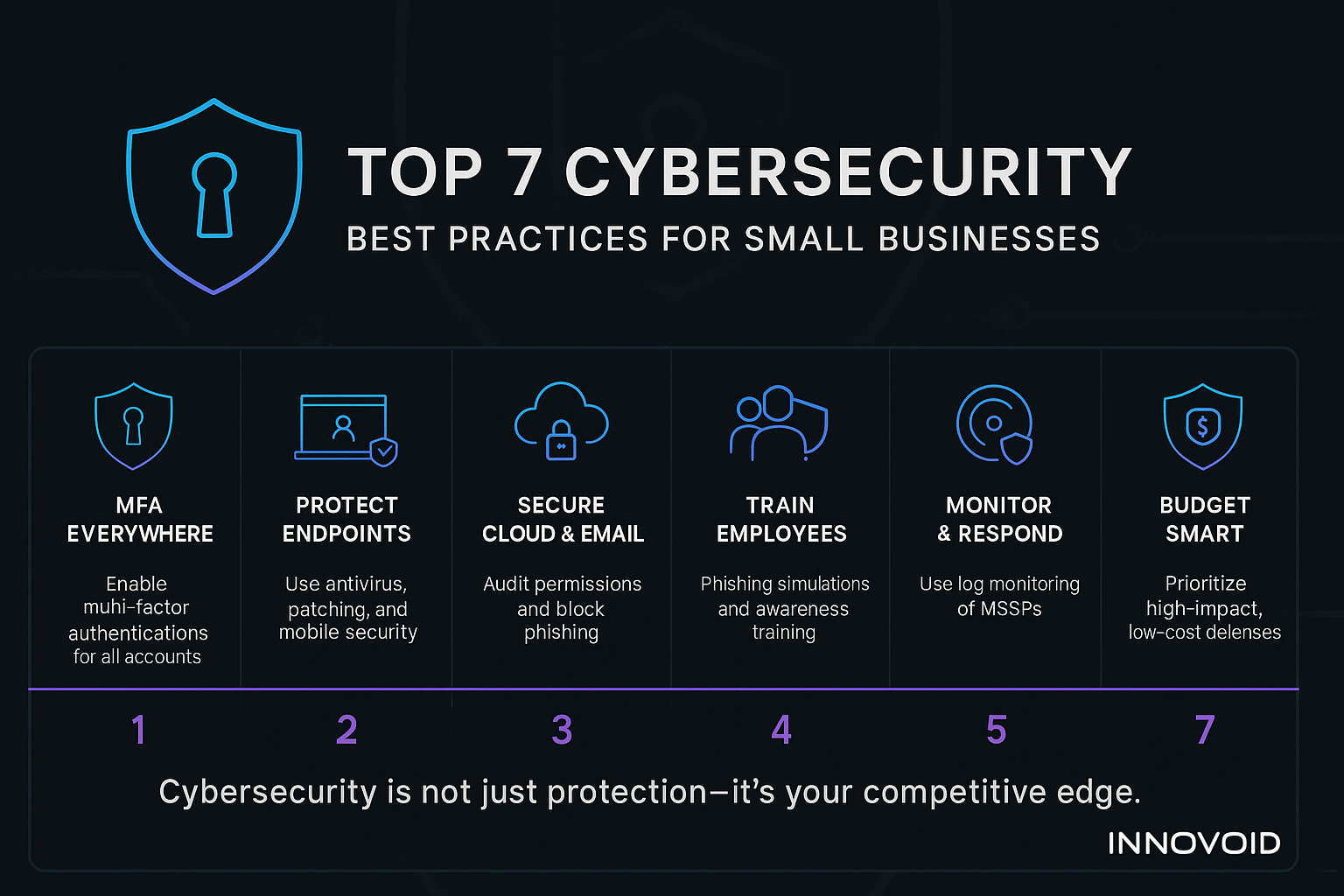
Cybersecurity is not just an IT responsibility—it's a business survival strategy
4. Back Up Like Your Business Depends on It (Because It Does)
Ransomware attacks surged in 2024 and remain a top threat in 2025. The best defense is resilient backups.
- Follow the 3-2-1 rule: 3 copies of your data, 2 formats, 1 offsite/offline.
- Automated cloud backups: Affordable and easy to manage for SMBs.
- Regular recovery drills: A backup is useless if you cannot restore it quickly.
5. Train Your People—Your First Line of Defense
Technology cannot stop a well-crafted phishing email if employees are not prepared.
- Quarterly phishing simulations to build awareness.
- Micro-trainings on spotting social engineering tactics.
- Clear reporting channels so employees know what to do when suspicious activity occurs.
6. Monitor and Respond Proactively
- Log monitoring: Even basic tools like Microsoft Sentinel or Splunk Starter can alert you to anomalies.
- Outsource where needed: Managed Security Service Providers (MSSPs) offer 24/7 monitoring without enterprise price tags.
- Incident response plan: Have a documented playbook—who to call, what to shut down, how to notify stakeholders.
7. Budget Smart, Not Big
Cybersecurity spending for SMBs is expected to hit record levels in 2025, but efficiency matters more than size.
- Use bundled tools from cloud providers to cut costs.
- Prioritize high-impact, low-cost defenses (MFA, backups, training).
- Leverage cyber insurance, but only after implementing baseline protections—insurers are tightening requirements.
The Forward View
In May 2025, cybersecurity is not just an IT responsibility—it is a business survival strategy. Small businesses that adopt these practices can protect customer trust, avoid costly downtime, and compete with confidence against larger players.
At Innovoid Tech, we believe cybersecurity should be a business enabler, not a burden. By combining practical measures with smart automation, SMBs can stay safe without breaking the bank.
Comments (0)
No comments yet. Be the first to share your thoughts!
Ready to Secure Your Business?
Let Innovoid Tech help you implement these cybersecurity best practices with cost-effective solutions designed for small businesses.
Get Started Today